
The pitch is simple. The same event trades on Kalshi and Polymarket. Buy Yes on one and No on the other for less than a dollar combined, and one of them pays out a dollar no matter what happens. Keep the difference.
That used to work fairly often. In 2026 it works less, pays less, and most of what’s left gets taken by bots. This page shows you the math with both platforms’ current fees, and the five ways an arbitrage loses money even when the prices look right.
How the trade works
Two versions.
Cross-platform. Kalshi prices Yes at 46 cents. Polymarket prices No on the same event at 51 cents. Buy both: 97 cents in, $1 out at settlement, 3 cents locked in per pair. (Those prices are made up to show the mechanics. Real gaps are usually smaller.)
Same-market. One market, every outcome. If all the Yes contracts in a multi-outcome market add up to less than $1, buy them all. Exactly one pays. Same idea, one platform.
The math after fees
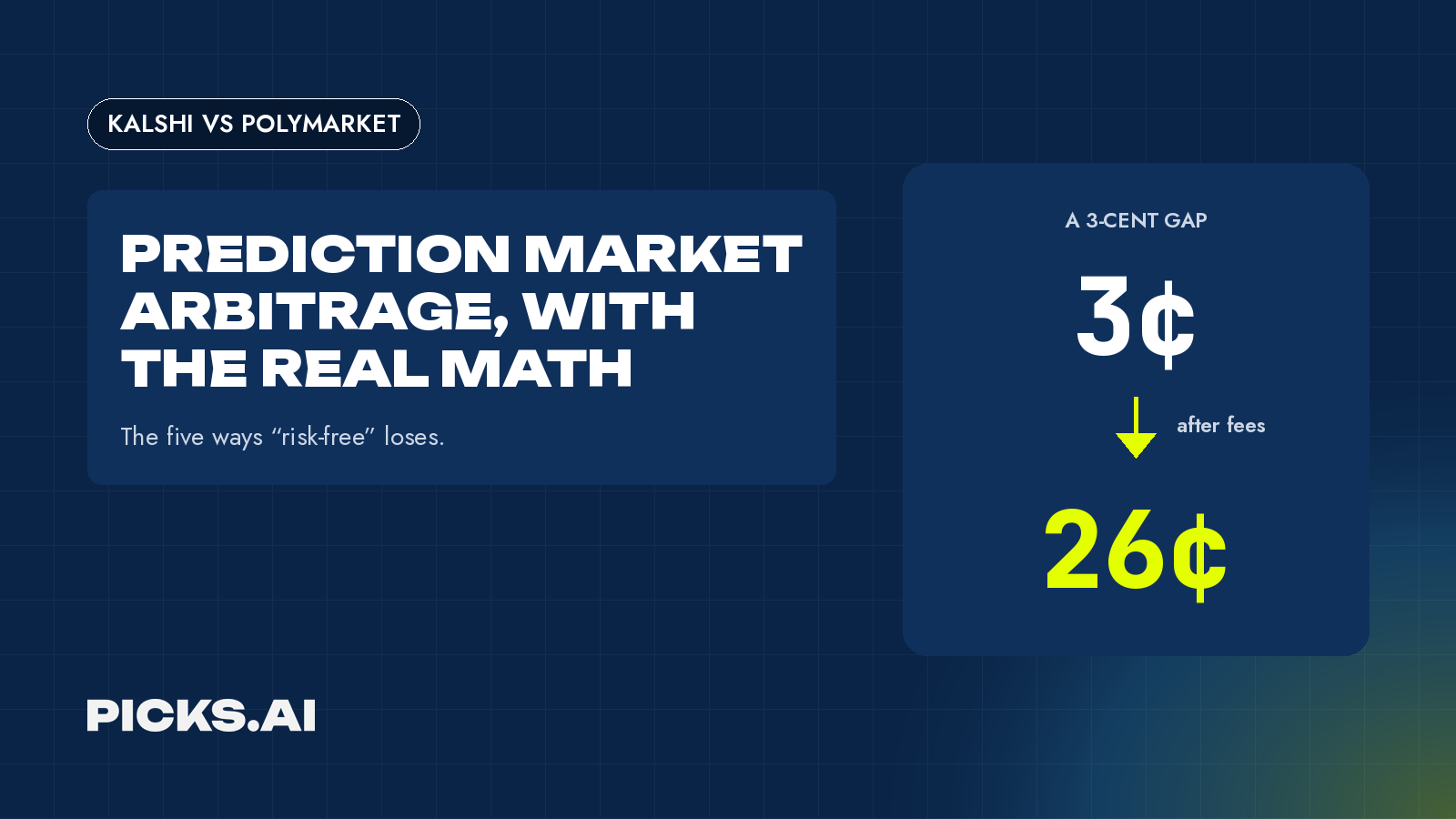
Most arbitrage pages stop at the gross gap. Here’s what happens after fees, using the same example: 100 pairs, Yes on Kalshi at 46 cents, No on Polymarket at 51 cents, a 3-cent gap, so $3.00 gross.
Kalshi’s taker fee is 7% of the contract price times the chance it loses, rounded up. At 46 cents on 100 contracts that’s $1.74.
Polymarket’s taker fee works the same way but the rate depends on the market category. Using the politics and finance rate of 4%, the fee on 100 contracts at 51 cents is about $1.00. (Polymarket started charging fees in stages during 2026 and the rates differ between its global site and Polymarket US. Check the current schedule for the category you’re trading. Our Polymarket fees guide keeps a dated table.)
| Amount | |
|---|---|
| Gross gap, 100 pairs | $3.00 |
| Kalshi taker fee at 46 cents | $1.74 |
| Polymarket taker fee at 51 cents (4% rate) | $1.00 |
| Left before spread and slippage | $0.26 |

A 3-cent gap turns into a quarter. On a sports market, where Polymarket’s rate has been reported at 5%, it turns into one cent. On a crypto market at 7% it goes negative.
And that’s before the spread. Every number above assumes you got the exact price on the screen. Cross the spread on both legs and the quarter is gone.
So how big does the gap need to be? At these prices, roughly 3 cents per pair just to cover both taker fees, and more once you add the spread on each side. Gaps that size are rare on liquid markets, and when they appear they close in seconds.
The maker version. Post limit orders instead of taking the price. On Kalshi’s standard markets, makers pay nothing. On Polymarket, makers pay nothing and can earn a rebate. Now the 3-cent gap is mostly yours.
The catch is the whole trade. One leg fills, the other sits there, and the price moves. You’re no longer arbitraging. You’re holding a naked position you never meant to take. That’s the hidden risk in every “post limit orders on both sides” strategy.
Why “risk-free” is wrong: the five ways it loses
1. The rules don’t match. Two markets can ask the same question and settle differently. Different official source, different deadline, different wording about ties or postponements. One resolves Yes and the other resolves No, and your hedge was never a hedge.
2. You’re too slow. By the time a human places the second leg, the first price has moved. Yahoo Finance reported this year that arbitrage bots dominate Polymarket, and a trader on Reddit who runs one says cross-platform gaps usually vanish within seconds. A gap you can see on a web page is a gap the bots have already seen.
3. Your money is locked. Both legs sit in your accounts until settlement. On a market that settles in a month, a 2-cent gross gap on a dollar is 2% for the month, minus fees. On a market that settles in six months, that same gap is a poor annual return even if everything goes right.
4. It doesn’t scale. A trader on Reddit shared the code and results from months of trying to arbitrage Polymarket’s 2024 election markets, about $225,000 of trading volume in total. That’s volume, not profit.
His conclusion was that there wasn’t enough liquidity. His own orders moved the prices against him and erased the gap. And some of his “complete” hedges didn’t cover every way the market could resolve. Worth reading, with the caveat that 2024 liquidity isn’t 2026 liquidity.
5. Convergence trades aren’t arbitrage. One widely shared “risk-free arbitrage” bot doesn’t hold to settlement at all. It buys both sides and sells when the gap between the platforms narrows. That’s a bet that prices will converge. It often works. It’s also speculation, with none of the guarantee the word arbitrage implies. Know which one you’re doing.

Does it still work in 2026?
Sometimes, in three places.
New markets. When a market lists on one platform before the other, or the books are young and thin, prices disagree for a while.
Thin markets. Less traffic, wider gaps. But the same thinness means you can’t move size without moving the price, which is exactly how the election trader lost his edge.
News moments. When something breaks, the two platforms reprice at different speeds. The gap lasts seconds.
Scanners and bots, and what they cost
Two things matter more than which scanner you pick.
Real-time order book depth beats price snapshots. A scanner that shows you a 5-cent gap from a snapshot a minute old is showing you a gap that’s probably gone, or one that only exists for the first ten contracts.
And never give any bot or scanner your wallet’s private key. Fake Polymarket bots on GitHub and npm stole traders’ wallets throughout 2026. Our Polymarket bot guide has the documented cases and a checklist.
Two platforms, two sets of rules
Arbitrage across Kalshi and Polymarket means funded accounts on both, and they don’t work the same way.
Kalshi takes dollars by bank transfer or card. Polymarket US takes dollars; the global Polymarket site takes USDC, and isn’t available to US users. Availability differs by state on both. Our Kalshi legality guide and Polymarket legality guide cover where each one works.
And you’ll have two sets of tax records at the end of the year. Our Kalshi taxes guide covers what each platform sends you and what it doesn’t.
Quick answers
Is prediction market arbitrage legal? Trading on price differences between platforms is allowed. Each platform has its own rules on what you can and can’t do with its API, so read them. This isn’t legal advice.
Is it really risk-free? No. See the five ways above. Mismatched rules and one-leg fills are the two that hurt most.
What’s the best Polymarket arbitrage bot? Whatever you use, keep your private key out of it.
Can I arbitrage Kalshi against a sportsbook? The same idea works, with the same risks, plus one more: sportsbooks limit or close accounts that do it consistently.
This isn’t financial advice. The math is the math; the rest is what we’ve seen trading both platforms with our own money.